


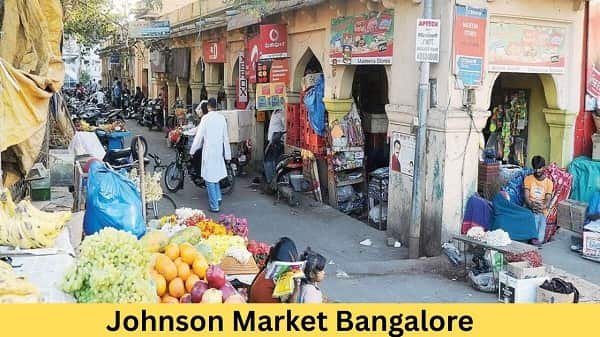
Johnson Market doesn’t announce itself. There’s no grand entrance, no polished signage, no attempt to look modern. You usually realize you’ve reached it only when the road narrows, the crowd thickens, and the smell of charcoal smoke and spice suddenly takes over.
This market is not a weekend attraction built for visitors. It is a working, breathing part of Bangalore’s everyday life—one that has survived almost a century without losing its core purpose. People come here to buy meat, drink tea, eat kebabs, and talk. That’s it. And that’s exactly why it still matters.
In a city racing toward glass towers and curated experiences, Johnson Market remains stubbornly real.
Located in the heart of old Bangalore
Johnson Market sits on Hosur Road in Richmond Town, one of Bangalore’s oldest and most layered neighbourhoods. The area has long been home to traders, churches, mosques, bakeries, and small businesses that predate modern Bengaluru by decades.
This central location keeps the market constantly active. Office workers drop in after work. Locals come for daily purchases. Food lovers arrive in the evening. During religious seasons, the crowd multiplies.
The market doesn’t shut down when the city sleeps. It simply slows, then starts again.
Johnson Market Quick Details
| Detail | Information |
| Location | Hosur Road, Richmond Town, Central Bangalore |
| Market Type | Heritage produce market & street food hub |
| Famous For | Seekh kebabs, Sulaimani tea, old bakeries |
| Nearest Metro | Trinity Metro (Purple Line) |
| Best Time to Visit | 6:00 PM – 11:00 PM |
| Status (2026) | Heritage structure; Pink Line work nearby |
A Short History of Johnson Market
Johnson Market was built in 1929, during the British era, and named after a British civil servant. But the land it stands on has a story older than colonial Bangalore.
Before the market existed, the site housed horse stables owned by Aga Ali Asker, a prominent Persian trader and philanthropist who played a major role in shaping central Bangalore’s development. His influence brought Persian and Shia cultural elements into the area—traces of which still survive today.
Unlike many old markets that were redeveloped or relocated, Johnson Market stayed where it was. It adapted without being erased. Over time, it became deeply tied to the local Muslim community, especially in food culture, while remaining open and accessible to everyone.
What you see today is not a restored heritage site. It is a functioning market that simply grew old while doing its job.
What Makes Johnson Market Different
Johnson Market is often described as “shabby chic,” but that misses the point. Nothing here is styled to look old. It just is old.
The shops are small and tightly packed. Many are family-run for generations. The same butcher, the same tea stall, the same bakery—often in the same spot for decades.
Languages mix freely. Kannada blends into Urdu, Tamil, Malayalam, and Hindi. Customers stand shoulder to shoulder. Bargaining is minimal. Regulars are recognised without words.
This market doesn’t perform for attention. It exists for utility—and that’s exactly what gives it character.
What You Can Eat Here
Food is the main reason people come to Johnson Market, especially after sunset.
1. Kebabs & Rolls
Open flames, skewers, and smoke dominate the evenings. Seekh kebabs are the star—juicy, spicy, and cooked fast.
Fanoos is the most famous name here, known for its heavy seekh rolls. Their roll sizes—Rambo, Shambo, Mambo, Mogambo—are almost as well known as the food itself.
2. Tea & Evening Snacks
Makkah Café is an institution. Order Sulaimani tea—black tea with lemon and mild spices—and onion samosas. Sit, sip, and watch the market move. Many people come here daily, not occasionally.
3. Biryani & Rice Dishes
Johnson Market is known for its beef biryani made with Seeraga Samba rice. At Khazana Food Paradise, the biryani is aromatic, light, and deeply flavoured without being oily or heavy.
4. Old-Style Bakeries
Tucked between meat shops and cafés are old bakeries selling dilpasand, coconut pastries, salt biscuits, and bread baked in wood-fired ovens. Recipes here haven’t changed in years—and that’s the point.
Ramzan Season at Johnson Market
Ramzan is when Johnson Market truly transforms.
From evening till late night, temporary stalls line the streets. Special dishes like Haleem and Harira appear. Families arrive after prayers. Groups gather around favourite vendors. The energy is constant and intense.
It gets crowded. Very crowded. But it also becomes one of the most vibrant food scenes in Bangalore. For many locals, visiting Johnson Market during Ramzan is a yearly ritual.
Transport, Metro & Bus Connectivity
Despite its old-world layout, Johnson Market is well connected.
- Metro: Trinity Metro Station on the Purple Line is the closest operational stop. As of 2026, construction on the Pink Line near Langford Town is ongoing and will make access easier once completed.
- Bus: BMTC buses like G-3, 143, and 146 stop directly at the Johnson Market bus stand.
- Auto: Autos are readily available and often the easiest option.
Parking Situation
Parking is the biggest challenge here.
Car parking is extremely limited, and the narrow roads make driving stressful. Two-wheelers are manageable, but even they require patience. Public transport or autos are strongly recommended.
Nearby Places to Explore
If you want to extend your visit:
- St. Gregorious Orthodox Cathedral – Right next to the market, calm and historic.
- MG Road & Brigade Road – Ten minutes away for shopping and nightlife.
- Richmond Park – A quiet green space nearby.
Best Time to Visit & Local Tips
- Visit after 6 PM for food stalls
- Fridays often have special biryanis and sweets
- Expect crowds during Ramzan
- Carry cash and UPI
- Dress comfortably and be patient
Conclusion
Johnson Market is not clean, quiet, or curated—and it doesn’t need to be.
It represents a version of Bangalore that still eats standing up, talks loudly, and values routine over reinvention. Every cracked wall and smoky grill tells a story of continuity.
If you want to understand the city beyond malls and cafés, come here hungry—and let the market do the rest.