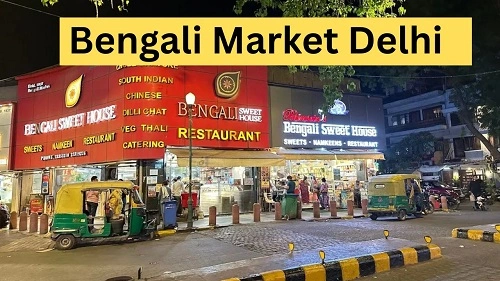
Tucked beside Mandi House, Bengali Market is one of New Delhi’s oldest and most loved food corners. Despite the name, it has no direct connection to West Bengal. Instead, it’s a compact circular market that has become legendary for North Indian chaat and sweets.
Small in size but big on reputation, the market revolves around a central roundabout with just a handful of iconic shops. It mainly serves residents of Lutyens’ Delhi, but it also attracts theatre audiences, office workers, and serious food lovers. People arrive for convenience — and leave talking about chhole bhature and gol gappas.
Bengali Market Quick Details
| Detail | Information |
| Location | Babar Road, Mandi House, New Delhi |
| Market Type | Heritage Food & Utility Market |
| Famous For | Chhole Bhature, Chaat, Indian Sweets |
| Nearest Metro | Mandi House (Blue & Violet Line) |
| Must-Try Food | Chhole Bhature, Sandesh, Paani Puri |
| Bargaining Rule | Not applicable (fixed prices) |
| Best Time | 12:00 PM–2:00 PM or 7:00 PM–9:00 PM |
| Sunday Status | Open |
Bengali Market History
Bengali Market was built in 1930 by Bengali Mal Lohia, which is where its original name “Bengali Mal Market” came from. Over time, locals shortened it to simply Bengali Market.
It sits inside the elite Lutyens’ Delhi zone and famously carries India’s first-ever postal code: 110001. In its early years, the area even housed families who later became business giants, including the Ambanis.
What began as a residential convenience market slowly evolved into one of Delhi’s most respected food destinations, especially after sweet shops and chaat counters gained cult status.
Food (What to Eat & See)
This market exists mainly for eating — and it does not disappoint.
Legendary Sweet Shops
Nathu’s Sweets and Bengali Sweet House dominate the circle. Both are famous for sandesh, rasgullas, laddoos, and seasonal mithai.
Chaat & Chhole Bhature
The chhole bhature here are among the most talked-about in central Delhi. Paani puri, aloo tikki, and papdi chaat draw steady queues every evening.
Local Utilities
Apart from food, you’ll find pharmacies, bakeries, small boutiques, and daily-need stores catering to nearby residents.
Theatre Crowd
Because of its proximity to National School of Drama, Bengali Market doubles as an informal hangout for actors and students between rehearsals.
Bengali Market Transport
Getting here is easy thanks to its central location.
Metro: Mandi House Metro Station is less than a five-minute walk and connects both the Blue and Violet Lines.
Bus: DTC buses stop at Kasturba Gandhi Crossing and Mandi House, both right nearby.
Railway: Tilak Bridge railway station and Shivaji Bridge railway station are within 2 km. New Delhi Railway Station is around 2.5 km away.
Parking is limited, so Metro is the easiest option.
Nearby Places to Explore
Because Bengali Market sits in central Delhi, several landmarks are close by:
- Connaught Place – colonial architecture and shopping
- India Gate – perfect for an evening walk
- Triveni Kala Sangam – art galleries and performances
- National School of Drama – plays and cultural events
Bengali Market Best Time to Visit
Lunch hours and evenings are busiest. For a calmer experience, weekday afternoons work best. Weekend evenings feel lively and social, though parking becomes difficult.
In conclusion, Bengali Market is proof that size doesn’t define legacy. This tiny circular market has held its ground against malls and food courts for nearly a century. It remains a place where Delhi’s history is tasted, not displayed — in plates of chaat, boxes of sweets, and conversations shared over hot bhature. For anyone wanting to experience old New Delhi through food, Bengali Market is essential.