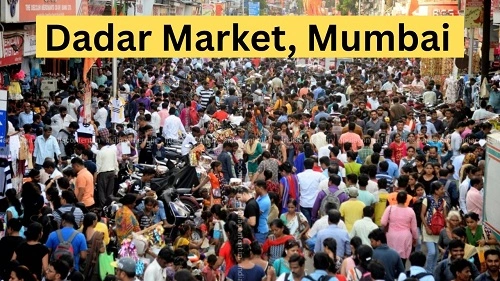
Dadar Market is one of Mumbai’s most intense and essential everyday markets. Located in the heart of the city, Dadar is not a single market but a cluster of multiple specialised markets—flowers, vegetables, fruits, fish, clothes, gold, and household goods—operating side by side in tightly packed lanes.
This is where Mumbai shops without filters. From early-morning flower auctions to late-evening vegetable bargaining, Dadar runs on speed, volume, and habit. Office workers, temple visitors, housewives, caterers, vendors, and traders all pass through here daily. It is chaotic, loud, and deeply efficient—very much Mumbai in spirit.
Dadar Market Quick Details
| Detail | Information |
| Location | Dadar (West & East), Central Mumbai |
| Market Type | Traditional wholesale & retail market cluster |
| Famous For | Flowers, vegetables, fish, clothes, gold |
| Nearest Railway | Dadar Railway Station (Western & Central Line) |
| Nearest Metro | Dadar West Metro (Line 3 – upcoming sections nearby) |
| Best Time to Visit | 6:00 AM – 11:00 AM / 5:00 PM – 9:00 PM |
| Closed On | Open all days (some sections close afternoons) |
Dadar Market History
Dadar developed as Mumbai’s first planned suburban node in the early 20th century. With railway connectivity on both the Western and Central lines, it became a natural trading and residential centre. Markets grew organically around temples, churches, and major road junctions.
The Dadar Flower Market (Phool Galli) is one of the oldest organised flower markets in Mumbai, supplying garlands to temples, weddings, and festivals across the city. Vegetable and fish markets grew alongside to serve the dense local population.
Over decades, Dadar became a price-setting market—rates decided here influence retail pricing across nearby suburbs.
Shops & Markets (What to Buy & See)
Dadar is best understood by sections.
1. Flower Market (Phool Galli)
Marigold, rose, jasmine, tuberose, lotus—sold in bulk every morning. This market peaks between 5 AM and 9 AM.
2. Vegetable & Fruit Market
Fresh daily arrivals from Maharashtra. Prices here are among the lowest in the city, especially early morning.
3. Fish Market
One of Mumbai’s busiest fish markets, selling pomfret, bombil, prawns, surmai, crabs, and seasonal catch.
4. Clothing & Saree Shops
Cotton sarees, Maharashtrian nauvari, ready-made garments, blouses, and tailoring shops dominate inner lanes.
5. Gold & Jewellery Lanes
Traditional gold jewellery stores serving wedding and festival buyers.
6. Household & Utility Goods
Steel utensils, puja items, kitchenware, plastic goods, and daily-use essentials.
This is not browsing shopping—it’s mission shopping.
Food & Street Life
Food is woven into Dadar’s rhythm.
1. Udupi & Maharashtrian Restaurants
Serving idli-dosa, thalipeeth, misal pav, and vada pav.
2. Street Snacks
Vada pav stalls near the station are legendary. Chaat and fresh juice counters operate all day.
3. Tea & Breakfast Stalls
Tea stalls run non-stop for vendors and shoppers from dawn onwards.
Food here is quick, affordable, and purpose-driven.
Dadar Market Connectivity
Dadar is one of Mumbai’s biggest transport hubs.
Railway
- Dadar Station connects Western and Central lines, making it accessible from almost anywhere in Mumbai.
Bus
- BEST buses run in all directions—Lower Parel, Bandra, Kurla, Chembur, and South Mumbai.
Road Access
- Major arterial roads pass through Dadar, but traffic congestion is constant.
Parking
- Extremely difficult. Metro, train, or walking is strongly recommended.
Walkability
- Markets are dense and best explored on foot.
Dadar Market Nearby Places to Explore
You can combine a Dadar visit with:
- Portuguese Church (Our Lady of the Immaculate Conception)
- Shivaji Park – morning walks and evening relaxation
- Plaza Cinema area – old-school eateries
- Lower Parel – malls and offices
- Matunga – South Indian food hubs
Best Time to Visit
- Early Morning (5:30–9:30 AM) – flowers, fish, vegetables
- Evening (5:00–9:00 PM) – retail shopping and food
Avoid mid-afternoons; many shops shut temporarily.
Who Should Visit
- Local residents
- Caterers and bulk buyers
- Temple and wedding shoppers
- Budget household buyers
- Anyone wanting to see “real Mumbai”
Not ideal for tourists seeking calm shopping.
Conclusion
Dadar Market, Mumbai is not polished and doesn’t try to be. It survives on habit, trust, and sheer volume. This is where Mumbai shops the way it always has—fast, focused, and without ceremony.
If you want to understand how the city feeds itself, dresses itself, and wakes up every morning, spend a few hours in Dadar. You’ll leave tired—but informed.
| Related Articles | |
| SP Road Computer Market Bangalore | Sector 17 Market Chandigarh |
| Vardaan Market Kolkata | Ulhasnagar Furniture Market Ulhasnagar |