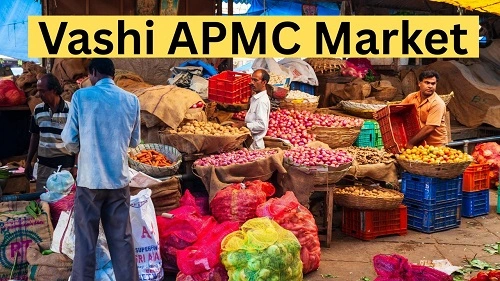
While many markets exist to serve shoppers, Vashi APMC Market exists to serve cities. Often called the Kitchen of Mumbai, this massive complex in Navi Mumbai decides what fruits, vegetables, grains, and spices reach plates across the Mumbai Metropolitan Region each day.
Located in Sector 19 near Vashi and Turbhe, the market operates at a scale that feels industrial rather than retail. Trucks arrive through the night. Deals close before sunrise. By the time the city wakes up, most of the freshest produce has already moved out.
As of 2026, Vashi APMC is entering a new phase, with a ₹750-crore redevelopment plan approved to modernize its aging but vital infrastructure—without slowing down the engine that feeds the region.
Vashi APMC Market Quick Details
| Detail | Information |
| Location | Sector 19, Vashi / Turbhe, Navi Mumbai |
| Market Type | Mega wholesale agricultural hub |
| Famous For | Alphonso mangoes, dry fruits, spices, grains |
| Nearest Railway | Vashi or Turbhe Railway Station |
| Best Time | 4:00 AM – 10:00 AM |
| Closed On | Sundays (most wholesale sections) |
History
Vashi APMC was developed to shift Mumbai’s wholesale agricultural trade away from congested South Mumbai. Over time, it grew into one of the largest wholesale markets in Asia, handling produce from across Maharashtra, Gujarat, Karnataka, and beyond.
The market became the primary entry point for agricultural goods into Mumbai—centralising supply, stabilising prices, and improving distribution efficiency. Entire supply chains evolved around it, from transporters and Mathadi workers to cold storage and exporters.
Despite its scale, much of the infrastructure aged without major upgrades. The newly approved redevelopment aims to modernise facilities while preserving the market’s operational rhythm.
Shops (What to Buy & See)
Vashi APMC is divided into five massive zones, often described as separate “kingdoms,” each with its own pace and purpose.
1. Fruit Market
The crown jewel of APMC. During summer, this becomes the global epicenter for Devgad and Ratnagiri Alphonso mangoes. Apples, oranges, grapes, bananas, and imported fruits arrive in huge volumes daily.
2. Vegetable Market
A vast sea of green where over a thousand trucks unload every day. From basic staples to exotic vegetables, this zone runs on speed and precision.
3. Grain Market
Warehouses stacked with rice, wheat, pulses, sugar, and flour. Most of Mumbai’s kirana stores source their monthly stock from here.
4. Masala (Spice) Market
Famous for Mirchi Galli, this section deals in chilies, turmeric, cumin, and large volumes of dry fruits like almonds, cashews, and dates—often at prices nearly 40% lower than retail.
5. Onion & Potato Market
A high-volume, high-intensity zone dedicated to India’s most essential kitchen staples, with constant price monitoring and movement.
Transport
Vashi APMC is built for logistics, not leisure.
By Train
Vashi Station (Harbour Line) is about 1.5 km away—a short auto ride. Turbhe Station is closer to the vegetable and grain sections.
By Bus
NMMT and BEST buses frequently stop at “APMC Market” and “Vashi Plaza.”
By Road & Parking
Located near the Sion–Panvel Highway, access is easy, but parking is extremely difficult due to constant truck movement. If driving, parking near the Central Facility Building is the safest option.
Always give way to Mathadi workers carrying heavy loads.
Nearby Places to Explore
If you’re done early and want a break:
- Vashi Plaza / Sector 9 & 10 – retail shopping and street food
- Inorbit & Raghuleela Malls – air-conditioned relief near Vashi station
- Mini Seashore – a quiet creek-side walk 10 minutes away
Best Time to Visit
Early morning is non-negotiable. Between 4:00 AM and 8:00 AM is when fresh arrivals peak and wholesale action is at full throttle. Retail buyers usually come slightly later, but prices and quality are best before 10:00 AM.
Avoid Sundays, when most wholesale sections remain closed.
Conclusion
Vashi APMC Market is not built for comfort or curiosity. It is built for scale. This is where Mumbai’s food supply enters, is priced, sorted, and sent outward at speed.
Dusty, loud, and relentless, the market is a reminder that cities eat because systems like this never sleep. For anyone wanting to understand how Mumbai is fed—this is where the story truly begins.