




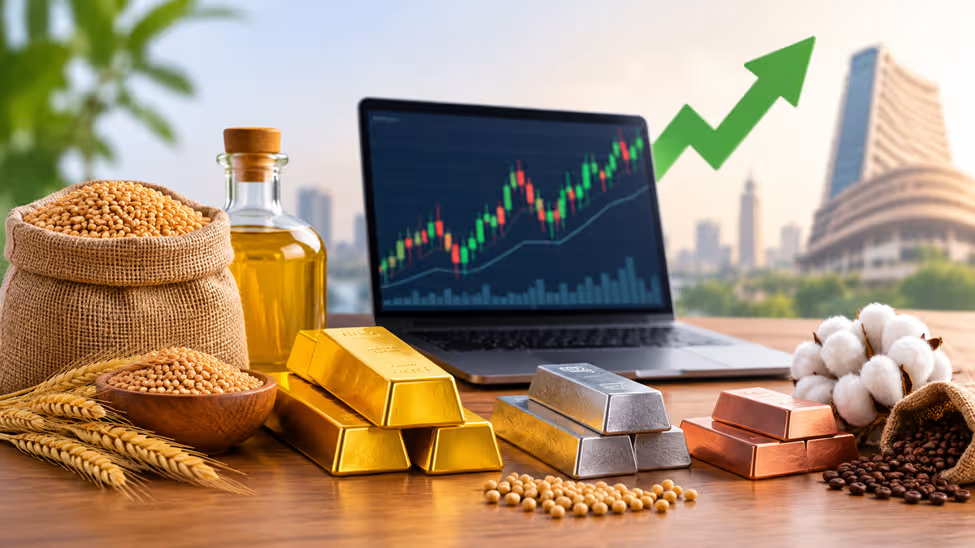
Commodities are basic goods that are used in everyday life and across industries. Gold, silver, crude oil, natural gas, cotton and agricultural products are some examples. Their prices can change due to factors such as supply, demand, weather, economic activity and global events.
For beginners, commodity trading can seem complex because each commodity has different price drivers and contract specifications. Understanding the basics can make it easier to see how commodity markets work, what can influence prices and what needs to be considered before entering a trade.
What Is Commodity Trading?
Commodity trading involves buying and selling contracts linked to the price of an underlying commodity. In India, commodity derivatives are traded through recognised exchanges, where contracts specify details such as quantity, quality, expiry and delivery conditions.
Traders do not necessarily need to buy and store the physical commodity. Instead, they can participate through derivative contracts whose value changes according to the underlying commodity’s market price.
Before starting, beginners should understand that commodity derivatives can involve leverage. This means a relatively small amount of capital can provide exposure to a larger contract value, but losses can also increase quickly.
Understanding the Types of Commodities
Commodities are generally divided into broad categories based on their underlying products. The main types of commodities include:
- Precious metals: Gold and silver are widely followed because of their investment and industrial uses.
- Base metals, copper, aluminium, zinc, and others, are used in manufacturing, construction, and infrastructure.
- Energy commodities: Crude oil and natural gas are influenced by global production, consumption and geopolitical developments.
- Agricultural commodities: Products such as cotton, soybeans, wheat, and other farm-based goods are affected by crop production, weather, and seasonal cycles.
Each category responds to different market conditions. Therefore, beginners should study the specific commodity they intend to trade rather than assume all commodities move the same way.
How to Start Commodity Trading in India
Getting started requires more than simply identifying a commodity and expecting its price to rise or fall. A beginner should first understand the trading process and the associated risks.
The following steps can provide a starting point.
1. Learn How the Market Works
Begin by understanding basic concepts such as futures contracts, expiry dates, lot sizes, margins and settlement. It is also useful to learn how commodity prices are affected by domestic and international developments.
For example, gold prices can respond to interest rates, currency movements and global economic conditions, while agricultural commodities may be more sensitive to rainfall, crop estimates and government policies.
2. Understand Contract Specifications
Every commodity derivative contract has defined specifications. These can include the contract size, quotation, expiry, delivery terms and margin requirements.
Reading these details before placing an order is important because the financial exposure depends on the contract size rather than simply the amount of money deposited in the account.
3. Study Price Drivers
Commodity prices are affected by different combinations of supply and demand factors. Beginners should identify the main drivers for the commodity they are following.
These may include:
- Production and inventory levels
- Domestic and international demand
- Weather and seasonal conditions
- Currency movements
- Government policies
- Global economic developments
- Geopolitical events
Following these factors can provide context for price movements and help beginners avoid relying solely on short-term price changes.
4. Understand Margin and Leverage
Derivative contracts generally require a margin rather than the full contract value upfront. This creates leverage, which can increase both potential gains and potential losses.
A beginner should understand how much capital is at risk and whether the position can be maintained if prices move against it. Additional margin requirements may also arise when market conditions become volatile.
5. Develop a Trading Plan
A trading plan can define the conditions under which a position will be entered, monitored and exited. It may include the amount of capital allocated, acceptable risk, position size and exit conditions.
Having predefined rules can reduce the tendency to make decisions based solely on short-term market movements.
What Factors Affect Commodity Prices?
Different commodities respond to different market forces. Understanding these influences is central to analysing the market.
For example, energy commodities can react to changes in global production, inventories and demand. Metals can be affected by industrial activity, mining output and currency movements. Agricultural products may respond to weather conditions, sowing patterns, harvest estimates and trade policies.
Global developments can also affect Indian commodity markets. International prices, currency movements and changes in major producing or consuming countries can influence domestic price expectations.
Risks Beginners Should Understand
Commodity derivatives can be volatile, and beginners should understand the risks before taking positions.
Some key risks include:
- Price volatility: Commodity prices can change sharply in response to unexpected events.
- Leverage risk: Losses can be magnified because derivatives provide exposure to a larger contract value.
- Market risk: Economic, political or supply-related developments can cause sudden price movements.
- Liquidity risk: Some contracts may have lower trading activity, which can affect execution.
- Expiry risk: Futures contracts have defined expiry dates, so positions cannot always be held indefinitely under the same contract.
Risk management is therefore an important part of participating in commodity markets. Traders should consider their financial position and risk tolerance before taking a position.
Common Mistakes to Avoid
Beginners can make costly decisions when they enter the market without understanding the underlying contract or price drivers. Avoiding common mistakes can help create a more disciplined approach.
Some mistakes include:
- Trading without understanding margin requirements
- Taking positions based on unverified tips
- Using excessive leverage
- Ignoring contract expiry dates
- Failing to account for potential losses
- Treating past price performance as a guarantee of future results
- Trading without a defined risk-management approach
Learning about these issues before placing trades can help beginners make more informed decisions.
Conclusion
Starting commodity trading in India requires an understanding of contracts, margins, price drivers and market risks. Beginners should take time to learn how the market operates rather than making decisions based only on short-term price movements.
Understanding the different Types of Commodities is equally important because metals, energy products and agricultural commodities can respond to very different factors. A disciplined approach to research, position sizing and risk management can help beginners participate in the market with a clearer understanding of the risks involved.