



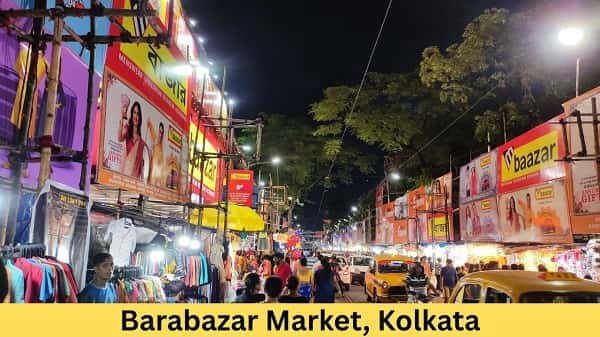
Barabazar Market, Kolkata is not just a market—it is an economy unto itself. Often spelled Burrabazar, this is Asia’s largest wholesale market and the commercial backbone of eastern India. If Kolkata runs on trade, Barabazar is the engine room.
Located in the heart of old Kolkata near Strand Road, this market supplies goods to retailers across West Bengal, the North-East, Jharkhand, Bihar, and Odisha. From spices and textiles to plastics and metals, almost everything passes through Barabazar at some point. It is loud, crowded, chaotic—and absolutely indispensable.
This is not a place you “visit.” It’s a place that works.
Barabazar Market, Kolkata Quick Details
| Detail | Information |
| Location | Burrabazar, Central Kolkata |
| Market Type | Mega wholesale trade hub |
| Famous For | Spices, textiles, plastics, hardware, dry goods |
| Nearest Metro | Mahatma Gandhi Road (Blue Line) |
| Best Time | 10:00 AM – 5:30 PM |
| Closed On | Sundays |
Barabazar Market History
Barabazar’s origins go back over 250 years, to the late 18th century, when Kolkata (then Calcutta) emerged as the trading capital of British India. The area grew around the old port and river routes of the Hooghly, making it a natural center for warehousing and wholesale trade.
Marwari, Jain, Gujarati, Armenian, and Chinese trading communities established businesses here, many of which continue across generations. Shops passed from grandfather to grandson, operating from the same narrow lanes for decades.
Despite fires, floods, colonial transitions, and modern regulations, Barabazar never stopped. It adapted, expanded vertically, and became denser—turning into the massive trade maze it is today.
Barabazar Market Shops (What to Buy & See)
Barabazar is divided into micro-markets, each specialising in a category.
1. Textiles & Fabrics
Sarees, dress materials, synthetic fabrics, cotton rolls, and garment accessories dominate several lanes. Retailers from across eastern India source stock from here.
2. Spices & Dry Goods
One of the largest spice trading hubs in India. Chillies, turmeric, cumin, cardamom, cloves, and masalas are traded in bulk sacks. The smell alone tells you where you are.
3. Plastics & Packaging
Containers, bottles, packaging materials, disposables—if a shop needs packaging, it likely came from Barabazar.
4. Hardware & Metals
Nails, pipes, fittings, wires, sheets, and industrial materials are sold wholesale to construction suppliers and factories.
5. General Wholesale Goods
Stationery, toys, household items, kitchenware, and festival supplies—sold by the carton, not by the piece.
Most shops sell only wholesale. Retail buyers are often redirected—or charged extra.
How Business Works Here
Barabazar runs on relationships.
- Orders are placed verbally
- Credit runs on trust built over years
- Loading and unloading is done by mathadi-style porters
- Goods move via handcarts, tempos, and small trucks
Phones ring constantly. Calculators never stop. Every minute matters.
Food & Street Life
Food exists to keep traders moving.
Simple Eateries
Rice, dal, sabzi, and curry joints serve fast lunches to workers and shopkeepers.
Tea Stalls
Every lane has at least one chai stall—often the center of negotiations and gossip.
Snacks & Sweets
Kachoris, samosas, and Bengali sweets are available near main crossings.
This is fuel, not indulgence.
Transport
Reaching Barabazar requires patience.
- Metro: Mahatma Gandhi Road Metro Station (Blue Line) is the most practical option. From there, most lanes are walkable.
- Railway: Howrah Station is nearby but crossing the bridge into Barabazar can be time-consuming.
- Bus: Numerous buses pass through Strand Road and Central Avenue.
- Parking: Almost non-existent. Cars are strongly discouraged. Walking is unavoidable.
Inside the Market: Handcarts rule. Pedestrians yield. There is no personal space.
Nearby Places to Explore
If you step outside the chaos:
- Howrah Bridge – iconic Kolkata landmark
- M.G. Road – electronics and repair market
- College Street – books and coffee houses
- Nakhoda Masjid – major religious site
- Chinese Temples (Tiretta Bazaar) – historic Chinatown area
Best Time to Visit
Late mornings to early afternoons on weekdays are best. Avoid Mondays (catch-up day) and Saturdays (peak congestion). Sundays are closed.
First-time visitors should go with a local guide or trader.
Who Should Come Here
- Retail shop owners
- Bulk buyers and traders
- Logistics and supply-chain professionals
- Anyone wanting to understand how Indian commerce really works
Tourists looking for souvenirs should stay away.
Conclusion
Barabazar Market, Kolkata is not beautiful. It is not comfortable. And it is not forgiving.
But it is one of the most important marketplaces in Asia. This is where prices are set, supplies are decided, and businesses survive or fail. It is raw capitalism in motion—unfiltered and relentless.
If you want to see how India trades at scale, Barabazar is the classroom.