



India’s property market is sending two seemingly contradictory signals in 2026. Developers are launching more residential projects, yet homes are taking longer to sell. Property prices continue rising in major cities, but buyers are becoming more selective about location, affordability, and construction quality.
These developments have raised an important question: Is the Indian real estate cycle reversing direction after several years of strong growth?
The latest market indicators suggest that India’s residential sector is moving from rapid expansion towards a more moderate phase. However, there is insufficient evidence of a nationwide property crash or a complete reversal into a prolonged downturn.
The distinction matters for homebuyers, investors, and developers because a slowing market can create different opportunities and risks than a falling market.
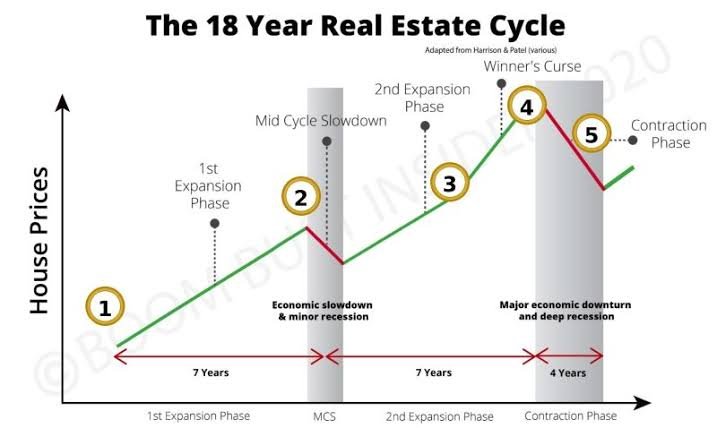
The Numbers Suggest a Market Losing Momentum, Not Collapsing
India’s housing market experienced substantial activity during the post-pandemic recovery, supported by housing demand, improving household confidence, and increased interest in larger homes.
By 2026, the pace of expansion had moderated.
Knight Frank India’s assessment of eight major cities recorded approximately 2.58 lakh residential sales during January–September 2026, broadly unchanged from the corresponding period in 2025.
During the same period, developers launched approximately 2.80 lakh homes.
This means new supply exceeded sales, increasing pressure on available inventory.
However, ANAROCK’s research showed a modest recovery during July–September 2026, with residential sales across seven major cities increasing approximately 3% year-on-year.
These findings are not necessarily contradictory. The consultancies examine different market coverage and datasets.
Together, they indicate that housing demand remains active, although growth has become less consistent.
Rising Inventory Is the First Important Warning
One of the clearest indicators of changing market conditions is the accumulation of unsold homes.
ANAROCK reported approximately 6.31 lakh available residential units across seven major cities at the end of September 2026, representing an annual increase of around 12%.
Increasing inventory does not automatically mean that developers are facing financial distress.
However, it can indicate that construction and new project launches are expanding faster than buyers are absorbing available supply.
If this continues, developers may eventually introduce more attractive payment plans, negotiate prices, or reduce future launches.
For investors, inventory growth deserves attention because it can influence resale competition and expected appreciation.
Why Property Prices Have Not Started Falling Nationwide
A genuine property market reversal is often associated with declining prices. Yet India’s major residential markets have generally continued recording annual price increases.
Knight Frank’s third-quarter 2026 assessment showed price growth across its tracked markets.
This creates an unusual situation: transaction growth is slowing, but prices remain relatively firm.
Several factors help explain the difference.
Developers may resist reducing advertised prices, particularly when construction costs and land acquisition expenses remain elevated.
Demand for well-located properties can also remain strong even when broader market activity weakens.
Additionally, average prices may increase when a larger proportion of expensive homes enters the market.
Therefore, rising average property prices do not necessarily mean that every individual apartment or locality has appreciated.
The Affordable Housing Segment Tells a Different Story
The most significant change in India’s housing cycle may be occurring across price categories rather than across the entire market.
According to Knight Frank’s January–September 2026 assessment, sales of homes priced below ₹50 lakh declined by approximately 14% year-on-year.
Meanwhile, homes priced between ₹2 crore and ₹5 crore recorded stronger sales growth.
This divergence suggests that affordability has become a major constraint for some buyers.
Households purchasing lower-priced homes are often more sensitive to:
- Changes in home loan interest rates.
- Rising property prices relative to income.
- Down payment requirements.
- Employment uncertainty.
- Registration and other transaction expenses.
- Availability of suitable housing near workplaces.
Premium buyers may have greater financial flexibility, although expensive housing segments also face risks when supply increases excessively.
Delhi-NCR Shows Why Local Analysis Matters
A national property market assessment can conceal substantial differences between cities.
Knight Frank reported an approximately 11% decline in residential sales across Delhi-NCR during the first nine months of 2026.
The weakness was particularly noticeable in certain expensive housing categories.
By contrast, Bengaluru recorded positive sales growth during the same period.
Other major markets experienced varying degrees of expansion or stability.
Even within Delhi-NCR, Gurugram, Noida, Greater Noida, and Ghaziabad have different demand conditions, infrastructure characteristics, and price trends.
India’s real estate cycle is not reversing uniformly. Some locations are cooling while others continue attracting substantial demand.
Is This the Beginning of a Bust Phase?
A market slowdown and a market bust are different economic conditions.
A slowdown involves weaker transaction growth, increasing inventory, and more cautious purchasing behaviour.
A bust generally involves more severe deterioration, potentially including substantial price declines, financial distress, and widespread project difficulties.
Current indicators are more consistent with market normalisation than a nationwide bust.
Nevertheless, continued increases in unsold inventory could create greater pressure if buyer demand weakens further.
Future market direction will depend partly on employment growth, household income, lending conditions, developer financing, and the relationship between new supply and actual housing demand.
What Homebuyers Should Watch During 2027
Instead of attempting to predict the exact market turning point, prospective buyers can monitor measurable changes.
Particularly useful indicators include:
- Inventory absorption: Whether completed and under-construction homes are selling faster or slower.
- Actual transaction prices: Whether registered sale values differ from advertised prices.
- Developer incentives: Whether discounts and payment benefits become more common.
- New project launches: Whether developers reduce supply in response to slower demand.
- Rental yields: Whether rental income reasonably supports investment valuations.
Homebuyers should also examine project registration under applicable RERA requirements, title documentation, construction progress, and the developer’s financial position.
A property should remain affordable even if expected appreciation takes longer than anticipated.
Frequently Asked Questions
Q1. Is India’s real estate market entering a downward cycle in 2026?
A: Current indicators suggest moderation rather than a confirmed nationwide downturn. Sales growth has slowed, inventory has increased, and affordability pressures remain significant, but residential prices have generally continued rising across major markets.
Q2. Will property prices fall in India during 2027?
A: A nationwide price decline cannot be predicted reliably. Some locations may experience corrections or greater negotiation opportunities, while areas with strong employment demand and limited suitable supply may remain resilient.
Q3. Which Indian housing segments are showing weakness?
A: Lower-priced housing has experienced weaker sales in several major markets. Certain premium segments, particularly where new supply has increased rapidly, are also showing signs of slower absorption.
Q4. Should homebuyers postpone purchasing property until the market reverses?
A: Not necessarily. Buyers should prioritise affordability, property quality, legal verification, and long-term housing requirements. Waiting for a nationwide price correction may be ineffective because individual locations behave differently.
Q5. What would confirm a major reversal in India’s property cycle?
A: Sustained declines in sales, increasing unsold inventory, widespread reductions in actual transaction prices, weaker rental demand, and growing developer financial stress would provide stronger evidence of a significant market reversal.