




A newly constructed apartment may have painted walls, functioning lifts, electricity connections, and families already moving in. Yet these visible signs of completion do not necessarily establish that the building has received permission for lawful occupation.
In India’s residential property market, this distinction is important because developers sometimes offer possession before completing every required regulatory formality.
An Occupancy Certificate (OC) is one of the documents that helps buyers determine whether a completed building has satisfied the applicable conditions for occupation.
Issued by the competent local authority, an OC generally indicates that the building has been assessed for compliance with relevant sanctioned plans and occupancy requirements.
However, an occupancy certificate is not a guarantee against every construction defect or legal problem. Understanding its purpose helps buyers distinguish regulatory approval from a developer’s assurance that a property is ready.
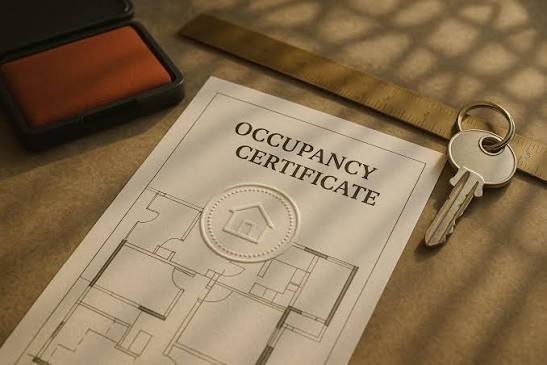
Why a Finished Building May Still Be Legally Unfit for Occupation
Construction completion and permission to occupy are separate matters.
A developer may finish the apartments while certain regulatory requirements remain outstanding.
For example, the building may have deviations from approved plans, incomplete fire safety arrangements, or unresolved requirements concerning essential infrastructure.
Depending on the applicable municipal rules, these issues can prevent the authority from granting occupancy approval.
The existence of electricity, water, or residents in a building does not automatically establish that all required permissions have been obtained.
This is why buyers should request documentary evidence rather than relying entirely on physical inspection.
What an Occupancy Certificate Actually Confirms
An occupancy certificate is issued under the building and development regulations applicable to the property’s location.
The precise checks differ between states, municipalities, and development authorities.
Generally, the certificate indicates that the competent authority has permitted occupation after considering applicable compliance requirements.
These may concern:
- Compliance with sanctioned building plans.
- Permitted building height and development parameters.
- Required fire safety clearances.
- Access and essential infrastructure.
- Applicable structural safety documentation.
- Completion of prescribed building services.
- Other conditions imposed by the approving authority.
An OC should be examined alongside the sanctioned plans and relevant approvals.
It does not independently establish ownership, eliminate mortgages, or guarantee that every aspect of construction workmanship is satisfactory.
How an OC Helps Protect Buyers Against Unauthorised Construction
Consider a residential project approved for a particular number of floors.
If the developer constructs additional floors without obtaining the necessary approvals, those portions may constitute unauthorised construction.
Such deviations can create difficulties during occupancy approval.
An OC provides buyers with an important opportunity to confirm that the authority has permitted occupation of the relevant building or portion.
However, buyers should verify the exact scope of the certificate.
An occupancy approval covering one tower does not necessarily extend to every tower in a large residential project.
Similarly, a partial occupancy certificate may permit occupation only of specified completed portions.
The document’s conditions and coverage matter as much as its existence.
Occupancy Certificate vs Completion Certificate
These documents are frequently confused, although their functions can differ.
A Completion Certificate (CC) generally concerns completion of construction in accordance with applicable requirements.
An Occupancy Certificate concerns permission to occupy the building.
In some jurisdictions, the approval process or terminology may combine aspects of completion and occupancy.
Therefore, buyers should check the specific rules followed by the local authority.
A developer’s construction completion letter should not automatically be treated as an official occupancy certificate.
The issuing authority and legal status of the document must be verified.
What Problems Can Arise Without an OC?
Purchasing or occupying a property without the required occupancy approval can create several difficulties.
The consequences depend on the applicable local regulations and the nature of the non-compliance.
Potential concerns include:
- Municipal action relating to unauthorised construction.
- Difficulties obtaining or regularising certain utility connections.
- Problems during resale transactions.
- Additional scrutiny from prospective lenders.
- Disputes concerning possession and project completion.
- Financial exposure arising from unresolved regulatory violations.
Not every missing certificate indicates that the entire building is illegal.
Sometimes an application may be pending because of incomplete documentation or outstanding compliance requirements.
Nevertheless, buyers should establish the reason for the missing approval before accepting possession.
The Connection Between Occupancy Certificates and RERA
The Real Estate (Regulation and Development) Act, 2016, places important obligations on promoters.
Under Section 11(4)(b), the promoter is responsible for obtaining the completion certificate or occupancy certificate, or both, as applicable, from the competent authority.
Section 19 also recognises allottee rights concerning relevant project information and documents.
These provisions help buyers distinguish a developer’s contractual promise from the regulatory approvals required for the project.
Where applicable, buyers may seek appropriate remedies if a promoter fails to fulfil statutory or contractual obligations.
However, the availability of a particular remedy depends on the facts, agreement, and relevant law.
How Buyers Can Verify an Occupancy Certificate
Verification should begin before the final payment or possession stage.
Ask the developer for a copy of the certificate and examine whether it identifies the correct project, building, and approved portion.
Where the local authority provides an online verification facility, buyers can compare the certificate details with official records.
Otherwise, verification may require contacting the issuing municipal corporation or development authority.
Important checks include:
- Name of the issuing authority.
- Certificate number and issue date.
- Project address and building identification.
- Floors or portions covered.
- Conditions or restrictions attached to approval.
- Consistency with the property’s sanctioned plans.
For example, buyers in Bengaluru may need to examine approvals issued by the relevant competent authority, while buyers in Mumbai must consider the applicable municipal approval framework.
The process should follow the property’s actual jurisdiction.
What Should Buyers Do If the Developer Offers Possession Without an OC?
The first step is to request a written explanation.
Ask whether the occupancy application has been submitted, whether any objections remain unresolved, and when approval is expected.
Buyers should also examine their agreement for sale and applicable RERA requirements.
Before accepting possession, consider obtaining independent legal advice about the consequences.
A verbal promise that the certificate will arrive soon does not provide the same protection as an officially issued approval.
Frequently Asked Questions
Q1. Is an occupancy certificate mandatory for every building in India?
A: Occupancy certificate requirements depend on applicable state and local building regulations. Many residential developments require occupancy approval, but exemptions and procedures can vary by jurisdiction and building category.
Q2. Can a developer legally hand over possession without an OC?
A: Where occupancy approval is legally required, offering possession without it can raise regulatory and contractual concerns. The precise consequences depend on local rules, the agreement, and applicable RERA provisions.
Q3. Does an occupancy certificate prove that a property has clear ownership?
A: No. An OC concerns permission for occupation and relevant building compliance. Ownership must be examined separately through title documents and supporting records.
Q4. Is a partial occupancy certificate valid?
A: A partial OC may be valid where the competent authority permits occupation of specified completed portions. Buyers must confirm that their particular building or apartment falls within its approved scope.
Q5. Can an occupancy certificate protect buyers from future demolition?
A: An OC provides evidence of regulatory permission to occupy, but it does not guarantee immunity from all future legal action. Fraud, material violations, or other legally significant defects may still lead to proceedings under applicable law.